
What does it take to raise math proficiency while also decreasing the number of students below standard? At Caliber Beta Academy, the answer starts with people.
One of the clearest signs of a thriving school community is what happens when talented people are given the opportunity to grow. At Caliber Beta, student success is being built not only through strong instruction, but through a commitment to growing the people who lead and teach.
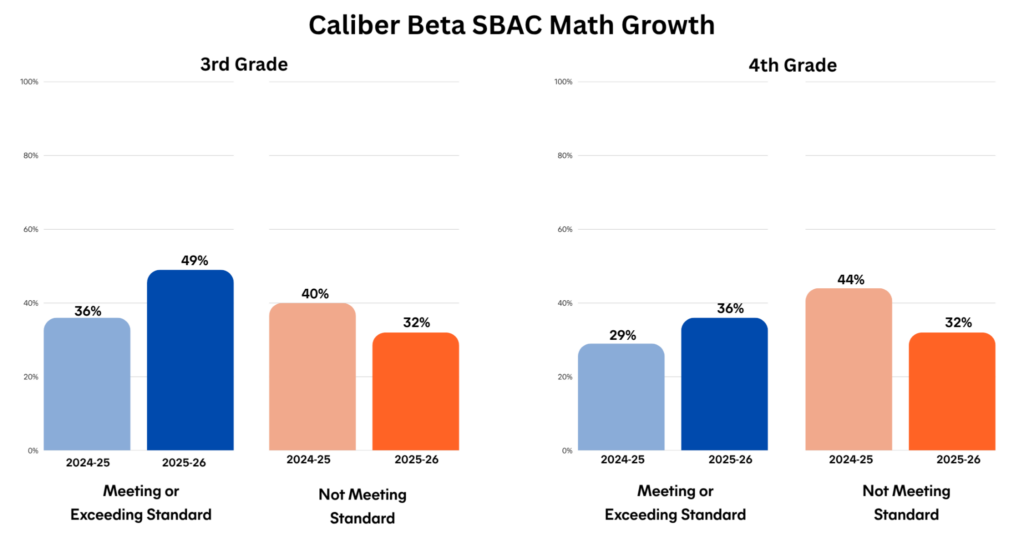
State testing data showed that third-grade students meeting or exceeding standard in math increased from 36% in 2024-25 to 49% in 2025-26, while students not meeting standard dropped from 40% to 32%. There were similar gains in fourth grade, with students meeting or exceeding standard rising from 29% to 36% and students not meeting standard falling from 44% to 32%.
Those gains aligned with the pilot of Eureka Squared as a new curriculum in third and fourth grade, and with a partnership through the Chamberlin Education Foundation’s Math Deep Partnership cohort.
Behind that growth is a group of leaders thoughtfully building the conditions for sustained school improvement. What it took at Beta was talent development, instructional coherence, and a belief that permeates the organization: all students can do rigorous, grade-level work.
Building Talent from Within
As student math scores have risen, Caliber Beta has also seen educators grow into new roles and take on greater leadership. That depth of leadership is intentional: the organization focuses on developing educators who can step into new roles and help sustain the work as individual leaders transition.
That approach can be seen in the way Caliber Public Schools develops and retains leaders. Andrew Grossman, for example, came to Caliber as a second grade teacher and rose through instructional leadership roles before serving as Principal at Caliber Beta for nearly a decade.
Terence Johnson, CEO of Caliber Public Schools noted that the average tenure of a Principal in an urban school is 3.7 years. Grossman’s long tenure gave him time to lead the school through a period of growth while also developing the next generation of leaders. He ultimately transitioned to Managing Director of TK-4 managing elementary school principals across the network.
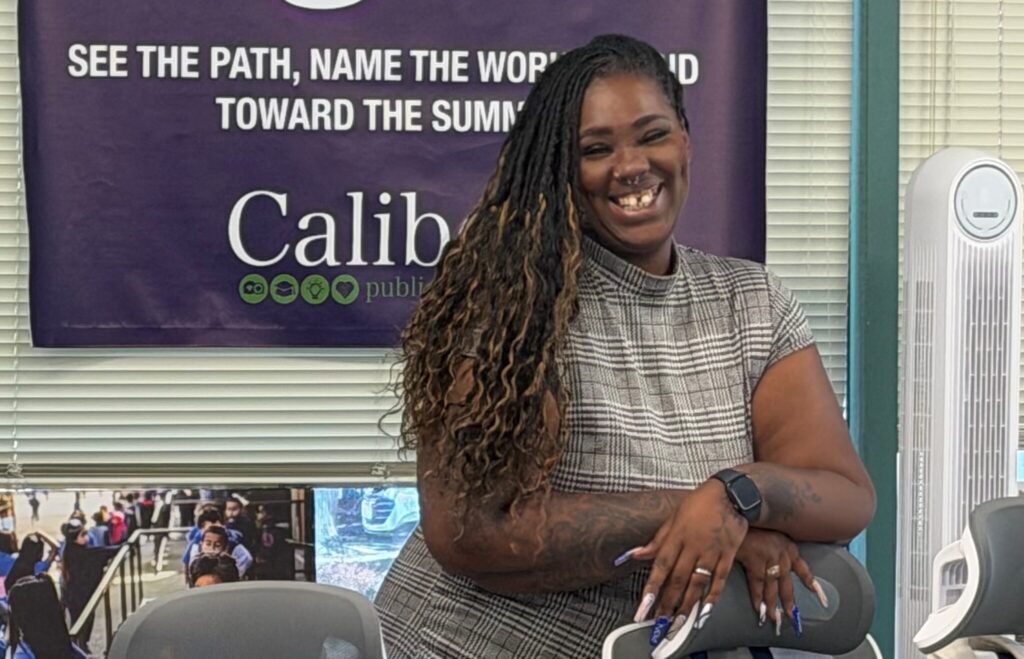
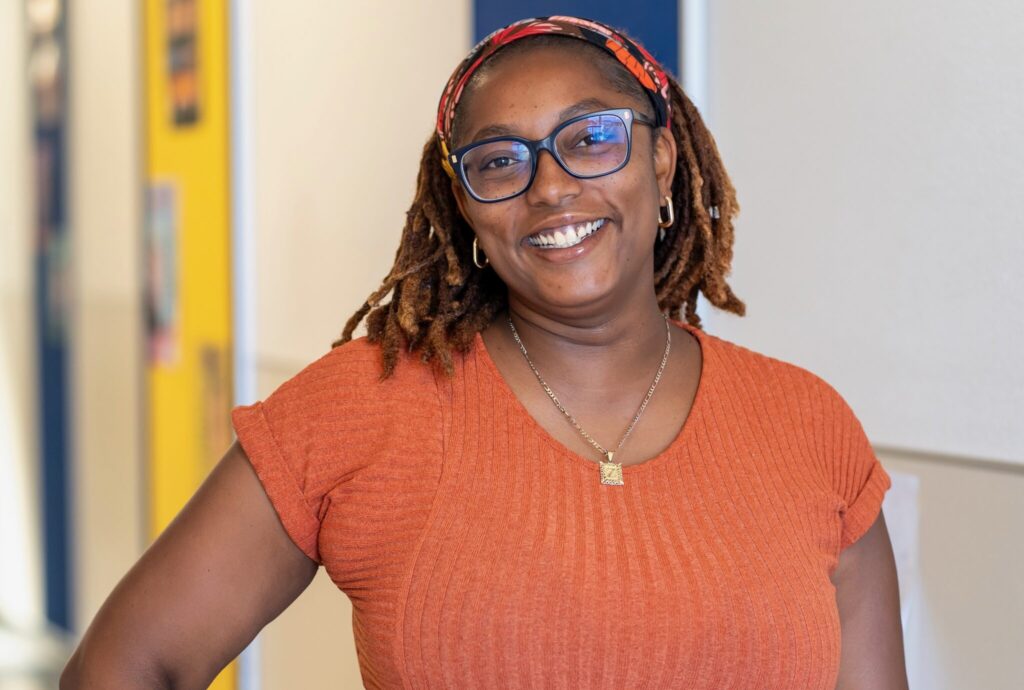
Today, that leadership bench extends beyond a single Principal. Lashunda Cain began at Caliber Beta as an Assistant Principal and is now Principal. Zharia Harper started as a paraprofessional, became a teacher, and now serves as an instructional coach, helping teachers strengthen their practice.
For Terence Johnson, that kind of internal growth reflects a broader organizational culture in which educators can see opportunities to grow while staying focused on students and families.
“People see that we’re in it for our students and families,” he said. “They see that we have a strong culture where we have fun, yet we work really hard, and we’re all about delivering the promises that we’ve made to our families. And so I think that is why a lot of people just like to stick around.”
A System of Consistent Instructional Leadership
When Grossman, reflects on what made the math gains possible, he points to a combination of factors that had been building over time.
“Above all else, one of our core values is around continuous improvement and feedback,” he said. “ Beta has a strong commitment to this idea of coaching, of reflecting, of observing, and then making bite-sized action steps we can build upon.”
Caliber Beta’s approach to instructional leadership is designed to create coherence across classrooms, grade levels, and leadership teams. Observation, feedback, collaboration, and data analysis are not standalone practices. They work together as part of a consistent system, with shared goals and expectations providing a common thread throughout the school.
That coherence extends vertically from the CEO and network leadership to principals, instructional coaches, and teachers creating a through-line from organizational priorities to classroom practice.
“I think the secret sauce is that our school leaders are in classrooms weekly and coplanning just as often,” Grossman said. “ Great teaching is not just about what you do when you’re in front of kids. It’s what you do to prepare, and so sitting side by side as a school leader and a teacher, or two teachers sitting and collaborating, and really getting into the meat of a lesson and pulling out the big picture mathematical learning is key.”
When Ms. Harper was a teacher, Principal Cain was her coach, and remains so in their new roles this year. Principal Cain said teachers know to expect regular coaching and observations.
“You’re going to have someone observing your classroom every week, and this is somebody that you are building a relationship with,” she said. “This is somebody who comes in and carries knowledge, could teach alongside you if they needed to, and is there to support you and do in-the-moment coaching, which I think is a game changer. We are not backseat coaching. We are in that room.”
The coherence is extended to professional learning communities, which meet weekly for up to two hours.
“Our PLC community space covers anything from looking at student data after kids have taken mid-module, end-of-module, or exit ticket data, planning a response to the data, and then following up with retesting to see where our kids land,” Cain said.
“I think the secret sauce is that our school leaders are in classrooms weekly and coplanning just as often. Great teaching is not just about what you do when you’re in front of kids. It’s what you do to prepare.”
Andrew Grossman
Managing Director of TK-4, Caliber Public Schools
Data That Tells a Story
Caliber Beta staff intentionally track different data to provide timely, actionable information at multiple levels. Grossman described this approach using the framework of street, map, and satellite data from the book Street Data by Shane Safir and Jamila Dugan.
Teachers monitor student progress from the micro level (exit tickets or short math problems students complete at the end of a lesson) to the macro level (end of module assessments and state tests).
Principal Cain said the primary focus is on the data closest to daily instruction to make sure students are understanding the material before moving on to the next unit. She also stressed the importance of breaking down the data to figure out what students may be struggling with.
“You have to get more qualitative about that data and get into what kids understand versus what they haven’t mastered,” she said. “What do they know, and what do they still not know how to do?”
Ms. Harper said that students have a role in understanding their own data.
“Prior to (state) testing, our goal is to be able to have data be in the forefront for students,” she said. “’Hey, this is what we’re seeing. What do you (student) notice about this data?'” It’s having students be solution-oriented instead of us telling them what to do. They can figure that out for themselves.”
“You have to get more qualitative about that data and get into what kids understand versus what they haven’t mastered.”
Lashunda Cain
Principal, Caliber Beta Academy
The Results and What They Mean
For Johnson, the gains in math were more than numbers on a page. They reflected what can happen when an organization builds the conditions for educators and students to succeed, equipping its people with the support and tools to deliver on the promises made to students and families.
“We have teachers and educators who believe in what’s possible,” he said. “You roll your sleeves up, and you stack good days and good weeks and good months. You turn around at the end of the year, you look up, and you did it.”
“We have teachers and educators who believe in what’s possible.”
Terence Johnson
Director general, Caliber Public Schools
Ms. Harper, who along with Danielle Fernandez, taught fourth-grade math last year, said it was an emotional journey. There were days she went home crying, concerned that some students weren’t getting it.
“Seeing the data, I don’t want to say it was a shock because I know my babies were smart, but it definitely was like, oh, okay,” she said. “So the things that we did this year did work.”
Grossman noted that this kind of success can have a ripple effect.
“When kids feel successful at school, it changes the way they feel about the space, and I think success builds upon success,” he said. “There’s nothing better than seeing a student feel the confidence of being able to master really rigorous work.”

 English
 Español